
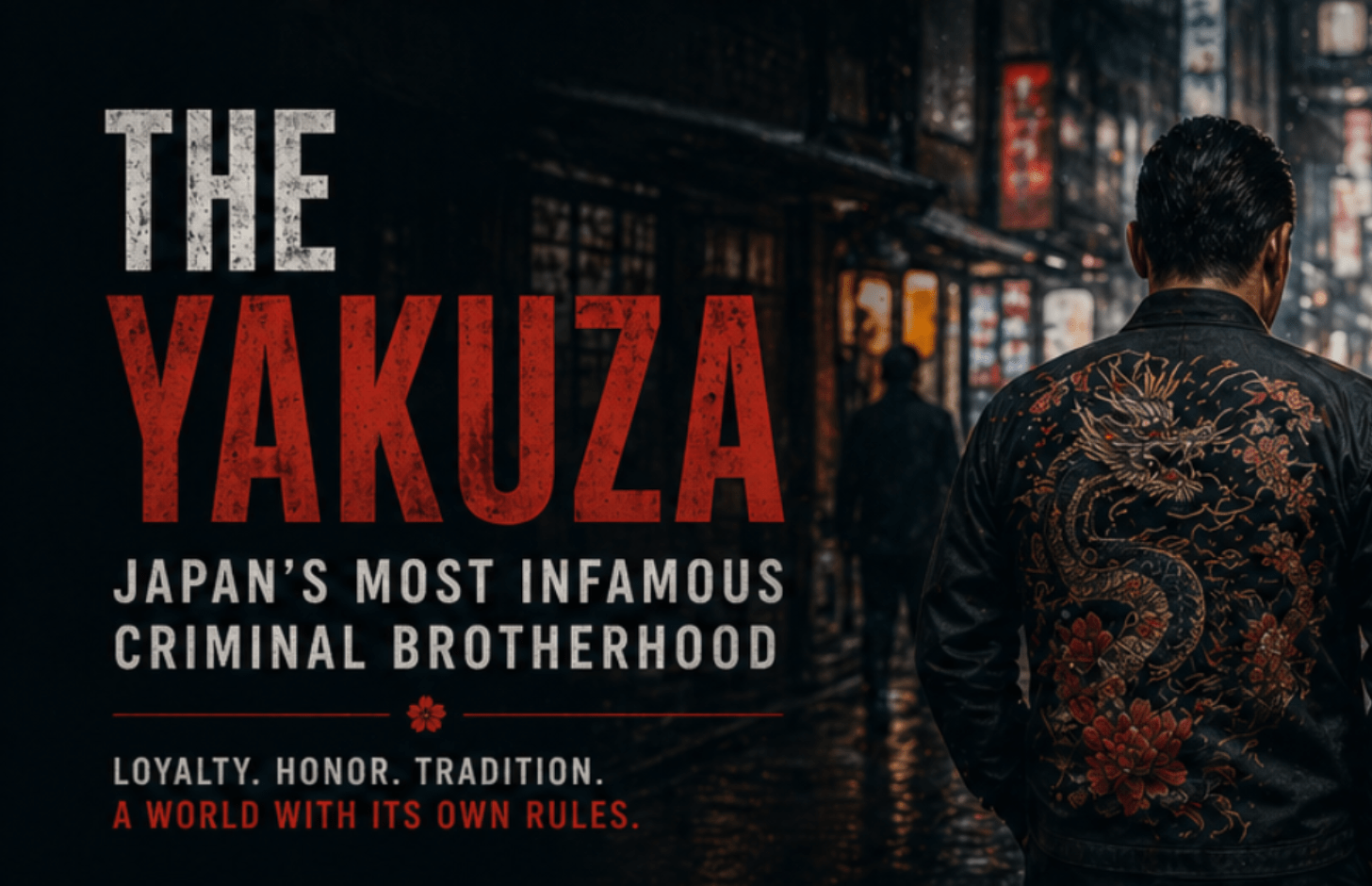
Few criminal organizations in the world have managed to operate as openly, as structurally, and as paradoxically as Japan’s Yakuza. Part crime syndicate, part social institution — the Yakuza is a world unto itself.
Introduction: A Criminal Organization Unlike Any Other
When most people think of organized crime, they imagine secretive underground networks operating in the shadows. The Yakuza breaks every one of those assumptions. For much of its history, this Japanese criminal brotherhood maintained registered offices with name plaques on the doors. Their bosses gave press interviews. Their members wore their affiliation like a badge of honor — quite literally tattooed across their bodies.
How does a criminal gang operate so openly in one of the world’s most law-abiding societies? The answer lies deep in Japan’s history, culture, and politics. The Yakuza story is not simply about crime. It is about loyalty, identity, power, and a strange kind of social belonging.
Where It All Began: Roots in the Edo Period
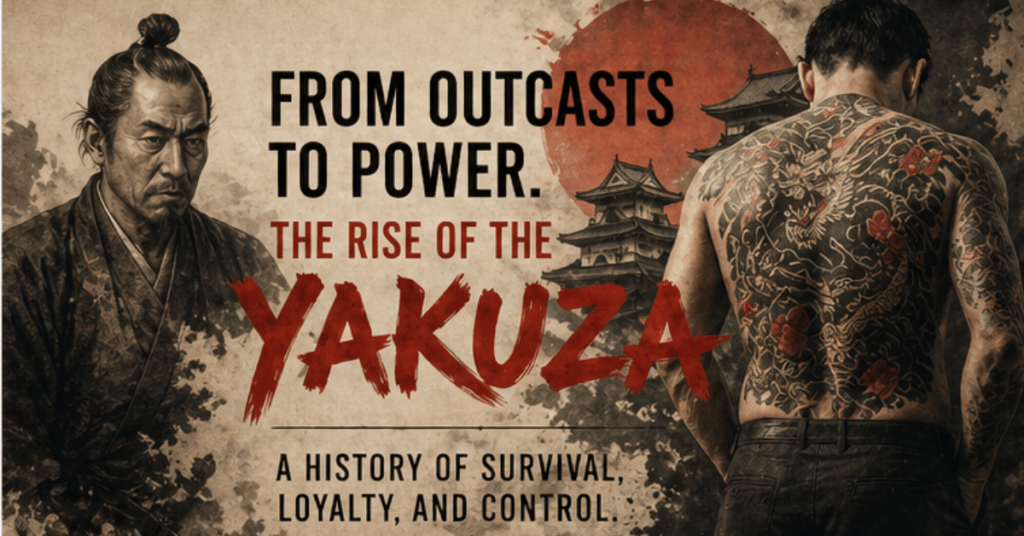
To understand the Yakuza, you have to go back to 17th century Japan — specifically the Edo period (1600s), when Japanese society was rigidly divided by class and status.
At the very bottom of this social ladder lived outcasts: people with no recognized place in the official hierarchy. Two groups in particular became the seeds of what would later become the Yakuza:
| Group | Who They Were | What They Did |
|---|---|---|
| Bakuto | Social outcasts, wanderers | Ran illegal gambling operations |
| Tekiya | Travelling street vendors | Sold goods at fairs and festivals, often using deception |
These groups developed their own internal codes, hierarchies, and loyalty systems — because society gave them no other option. Over generations, these tightly-knit underground communities evolved, merged, and transformed into the organized criminal gangs we now call the Yakuza.
Even the word “Yakuza” carries this spirit of being an outsider. It comes from a losing hand in the traditional Japanese card game Hanafuda — the combination of 8 (ya), 9 (ku), and 3 (za). A hand worth zero. A hand that loses. The Yakuza named themselves after failure, embracing the identity of those whom society had discarded.
The Cold War Connection: How America Helped the Yakuza Grow
One of the most surprising chapters in Yakuza history involves the United States government.
After Japan’s defeat in World War II (1945), the country was in ruins — economically devastated and politically unstable. As the Cold War began to take shape, American intelligence agencies grew alarmed at the growing influence of communist ideology among Japan’s labor unions and political left.
The solution? The CIA allegedly formed a covert alliance with the Yakuza.
The logic was brutal but pragmatic. The Yakuza were already powerful, nationalistic, and deeply anti-communist. They were given political cover to intimidate union leaders, break up leftist rallies, and suppress any organized communist movement on Japanese soil.
In return, the Yakuza gained something invaluable: political tolerance. With government and intelligence agencies looking the other way, the Yakuza were free to expand their operations, build their networks, and embed themselves deeply into Japanese business and politics.
This Cold War chapter explains much of why the Yakuza were able to grow so powerful for so long without serious interference from Japanese authorities.
Inside the Machine: The Nine Levels of Yakuza Hierarchy
One of the most striking features of the Yakuza is just how organized they are. This is not a loose gang of criminals. It is a multi-layered corporate structure with clearly defined roles, responsibilities, and career progression.
| Level | Role | Core Responsibilities |
|---|---|---|
| 1 | Entry-Level Member | Menial tasks, psychological endurance tests, no pay, building absolute loyalty |
| 2 | Earner | Generating income through gambling, extortion, and protection rackets |
| 3 | Younger Brother (Soldier) | Front-line operations, training new recruits, managing small territories |
| 4 | Office Worker | Transitioning from street violence to managing finances through legitimate businesses |
| 5 | Damage Control | Handling legal issues, managing police contacts, covering tracks for arrested members |
| 6 | Regional Boss | Controlling entire city regions, engaging in economic warfare against rival factions |
| 7 | Operations Chief | Planning high-level violent actions, tracking police movements, strategic coordination |
| 8 | Underboss | Managing finances, political connections, real estate — essentially the gang’s CEO |
| 9 | Supreme Boss | Ultimate authority over territories and inter-gang negotiations, living under constant threat |
Starting at the bottom means starting with nothing. New recruits perform the most degrading tasks imaginable. They are tested psychologically — sometimes through simulated torture — to see whether their loyalty is real or fragile. There is no salary. There is no respect. There is only the slow, painful process of proving yourself worthy of belonging.
Those who survive rise through the ranks over years, even decades. By the time someone reaches the upper levels, they have given the organization the most productive years of their life.
The Rituals That Bind: Tattoos and Finger-Cutting
What makes the Yakuza’s loyalty system so powerful — and so difficult to escape — are its physical rituals. Two in particular stand out.
Yubitsume: The Finger-Cutting Ritual
When a Yakuza member makes a serious mistake, disrespects a superior, or causes trouble for the gang, they are expected to atone in a very specific way: by cutting off the tip of their little finger with a blade and presenting it to their boss.
This practice has deep roots. Historically, samurai gripped their swords primarily with the little and ring fingers. Removing the tip of the little finger weakened a warrior’s grip — symbolically making them more dependent on their group for protection. For the Yakuza, the meaning carries forward: you have weakened yourself, and now you rely on your brothers for strength.
The ritual also serves a practical purpose. A missing fingertip immediately marks someone as a former or current Yakuza member, making it almost impossible to blend back into mainstream Japanese society.
Irezumi: The Art of the Full-Body Tattoo
Yakuza tattoos are among the most elaborate in the world. Full-body designs — covering the torso, arms, and legs while leaving a strip of untattooed skin down the chest — take years and enormous amounts of money to complete.
Common motifs include:
- Dragons (power and protection)
- Tigers (strength and courage)
- Phoenix (resilience and rebirth)
- Cherry blossoms (the beauty and fragility of life)
In Japan, tattoos carry a heavy social stigma, historically associated with criminals and outcasts. For the Yakuza, this stigma is precisely the point. The tattoo is a permanent declaration: I belong to this world. I am not going back.
Both rituals — the missing finger and the elaborate tattoo — function as social locks. They make leaving the Yakuza not just emotionally difficult but practically impossible. Where would you go? Who would hire you? Who would accept you?
The Paradox: Criminals Who Deliver Disaster Relief
Here is where the Yakuza story becomes genuinely complicated.
For all the violence and criminality, the Yakuza have repeatedly shown up to help ordinary Japanese people during their darkest moments — when the government was still organizing its response.
1995 Kobe Earthquake When a massive earthquake struck Kobe, killing over 6,000 people, the Yamaguchi-gumi — Japan’s largest Yakuza faction and based in Kobe — mobilized faster than almost anyone. They distributed food, medicine, and blankets, and sent members to patrol the streets to prevent looting. Locals who had lost everything remember receiving help from tattooed men in leather jackets.
2011 Tohoku Earthquake and Tsunami After one of Japan’s most devastating natural disasters, the Inagawa-kai faction quietly sent trucks loaded with supplies into affected areas. They worked discreetly, some members reportedly not wanting the publicity, understanding that open association with Yakuza assistance might embarrass the recipients.
These acts of charity don’t erase the criminal enterprise. But they explain something important about the Yakuza’s enduring presence in Japanese society: they exist in a relationship with their communities. They are not simply predators. They are, in a twisted way, a part of the social fabric.
One Name, Many Gangs: The Yakuza Umbrella

A common misconception is that the Yakuza is a single organization with a single boss. In reality, “Yakuza” is an umbrella term covering multiple independent criminal syndicates, each with its own leadership, territory, and culture.
The three most prominent factions are:
| Faction | Key Characteristics |
|---|---|
| Yamaguchi-gumi | Largest Yakuza group, based in Kobe, operates nationwide |
| Inagawa-kai | Tokyo-based, one of the oldest syndicates |
| Sumiyoshi-kai | Second largest in Tokyo, known for more corporate-style operations |
These groups have their own internal politics, rivalries, and occasionally violent conflicts. When leadership struggles within a faction get bad enough, splinter groups break off and form rival organizations — a pattern not unlike the internal fractures seen in the Italian Mafia.
The Fall: Yakuza in Decline
The era of the openly operating Yakuza began to end with the introduction of anti-organized crime laws in 1991 — and has been accelerating ever since.
Membership Over the Decades:
| Year | Estimated Yakuza Membership |
|---|---|
| 1963 | 188,400 |
| 1991 | ~90,000 |
| 2010 | ~80,000 |
| 2021 | 24,000 |
| 2024 | 18,800 |
What drove this collapse? A systematic campaign to make Yakuza membership economically and socially untenable.
Under modern Japanese law, simply doing business with a known Yakuza member can expose a company to legal liability. Banks are required to close accounts of identified members. Insurance companies deny coverage. Landlords cancel leases. Hospitals can refuse treatment for non-emergency procedures.
The result is a form of civil death. Yakuza members find themselves unable to open bank accounts, rent apartments, get loans, find legal employment, or even enroll their children in certain schools.
Ironically, this creates a cruel trap. Thousands of members want to leave the Yakuza — but the same stigma that punishes active members also punishes former members. Ex-Yakuza face the same discrimination, making reintegration into Japanese society extraordinarily difficult.
Why the Yakuza Doesn’t Fight Back
Given their history of violence and their still-significant numbers, one might wonder: why don’t the Yakuza simply push back against the government crackdown?
The answer reveals something important about how the Yakuza think. Their strength has never come from brute force alone — it has come from operating quietly within the system, maintaining influence through economic control, political connections, and the strategic avoidance of chaos.
An all-out war with Japanese law enforcement would result in total destruction. The Yakuza know this. So they have chosen strategic retreat: consolidating power, going underground where necessary, and waiting.
Whether they can survive this long retreat is an open question.
Final Thoughts: A Criminal World Like No Other
The Yakuza represent something genuinely unique in the global landscape of organized crime. They built an empire not just through violence but through structure, loyalty, ritual, and a paradoxical sense of community responsibility.
They were born from society’s outcasts and grew powerful enough to influence governments. They helped rebuild communities after disasters. They tattooed themselves into permanence. And now they are facing an existential decline — not through military defeat, but through economic and social isolation.
Japan’s Yakuza story is ultimately a human story: about belonging, about identity, about what people do when mainstream society leaves them no place to stand.
Whether the Yakuza survives the 21st century or quietly fades away, its legacy in Japanese history — complicated, dark, and deeply human – will not disappear anytime soon.
This blog info and details taken from youtube channels @SciCoLens & @realwillpowerstar