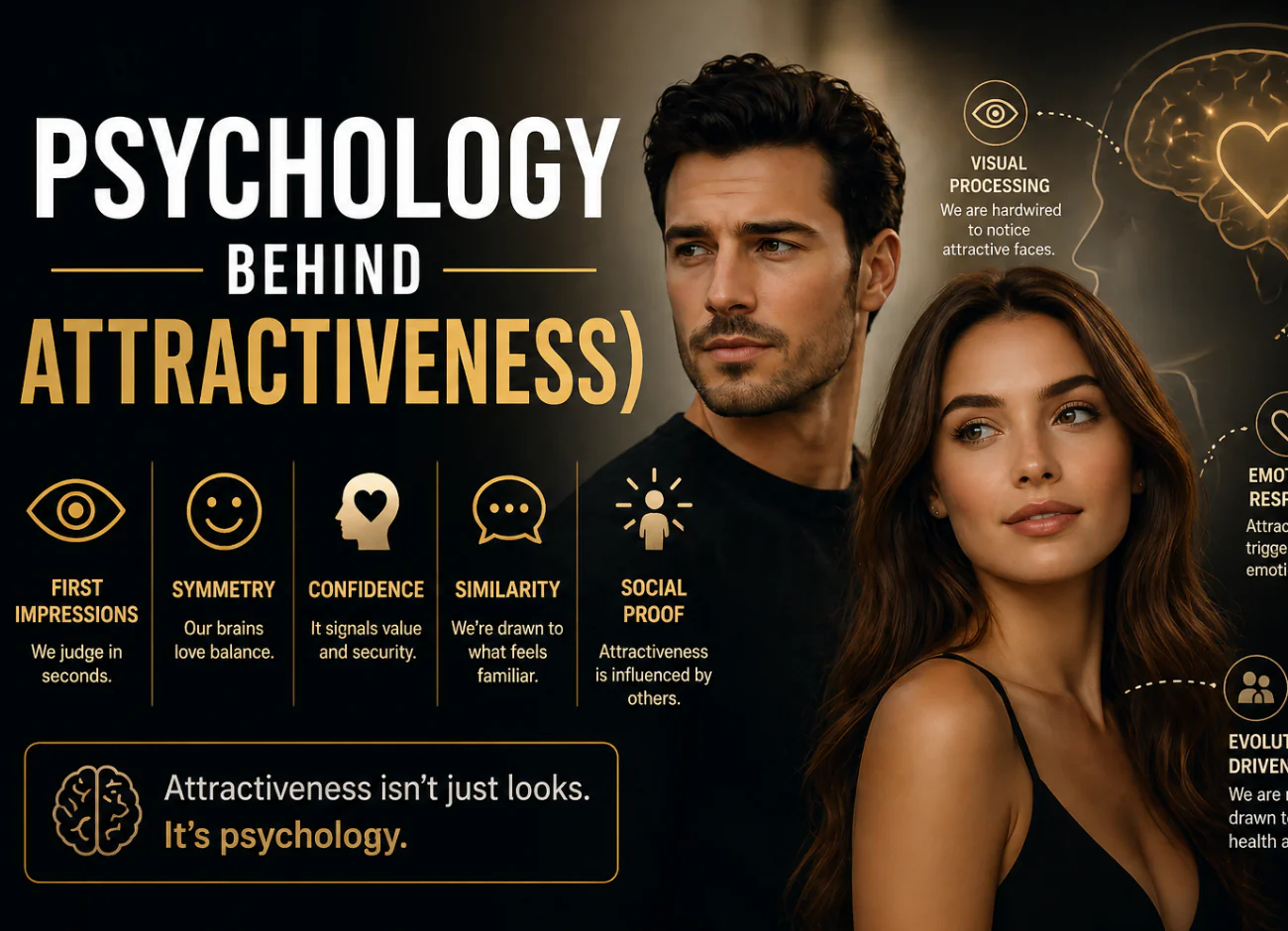

The Uncomfortable Truth Most Men Never Hear

There is a piece of advice that gets repeated endlessly in every corner of relationship culture — be kind, be safe, be loving, and she will come around. It sounds reasonable. It feels morally correct. And in practice, it almost never works the way men expect it to.
Here is why. Kindness, emotional safety, and genuine care are not attraction triggers on their own. They are qualities that women deeply value — but only once attraction already exists. Trying to win someone over through niceness alone, without addressing the underlying question of whether attraction is present, is like watering a plant that has not yet been planted.
This does not mean kindness is wrong. It means the sequence matters. Understanding that sequence is where everything begins.
Attraction and Long-Term Love Are Two Completely Different Skills
This is the distinction that most relationship advice collapses, and collapsing it causes enormous confusion.
| Attracting Someone | Keeping Someone |
|---|---|
| Based on first impressions and projected ideals | Based on who you actually are over time |
| Happens quickly, sometimes within minutes | Builds slowly across months and years |
| Driven by mystery, status, and presence | Driven by consistency, depth, and emotional honesty |
| Easy to get right by accident | Requires deliberate, ongoing effort |
| Fantasy fills in what is unknown | Reality replaces fantasy — for better or worse |
The moment a relationship moves past the early stage, something shifts. The idealized version of a person that both partners were quietly projecting onto each other begins to dissolve. What remains is the actual human being — with real habits, real flaws, real moods. This is what some psychologists call the crisis of disappointment. It sounds alarming, but it is actually the real beginning of a relationship. Everything before it was largely imagination.
Most relationships do not survive this transition not because the people are incompatible, but because neither person knew it was coming or how to navigate it.
How to Actually Become More Attractive
Physical appearance matters — but far less than the broader picture of how a man carries himself, communicates, and moves through social environments. Here is an honest breakdown.
| Area | What Low Attractiveness Looks Like | What High Attractiveness Looks Like |
|---|---|---|
| Physical presentation | Poor hygiene, no exercise, dressing without thought | Clean, fit, dressed with intention |
| Communication | Talking only about facts, logic, and content | Creating emotional resonance and genuine connection |
| Social presence | Nervous, seeking approval, shrinking in groups | Calm, grounded, comfortable taking up space |
| Humor | Sarcastic, punching down, performing for validation | Effortlessly lightening moments without cruelty |
| Confidence | Dependent on external feedback | Rooted in self-knowledge and consistent action |
The one area that deserves special attention is communication — specifically the gap between how men and women naturally tend to communicate.
Men often default to what could be called semantic communication — the literal meaning of words, the logical structure of a conversation, the point being made. Women more naturally gravitate toward emotional resonance — not just what is said, but how it feels to be in the conversation. Think of two tuning forks placed near each other. When one vibrates at the right frequency, the other begins to hum in response without being touched.
Learning to communicate in a way that creates genuine emotional connection — not manipulative, not performed, but authentically engaged — is one of the highest-leverage things a man can develop.
The Role of Money, Fame, and Status — Honestly
Money attracts attention. Fame creates status hierarchies. Power opens doors. None of this is a secret, and pretending otherwise is dishonest.
But here is what often gets left out of that conversation.
Money is a proxy for attraction — not attraction itself. It signals capability, ambition, and security. Those qualities are genuinely appealing. But money without the underlying qualities it is supposed to represent creates relationships built entirely on transaction. They are fragile, shallow, and usually brief.
Fame works similarly. Even small-scale social recognition — being well-regarded in a community, being genuinely respected among peers — creates a kind of status that generates interest. But again, it is the qualities beneath the status that determine whether anything real develops.
The men who rely purely on money or fame to attract partners eventually discover that those tools can get someone in the door, but they cannot make anyone stay.
The shift toward building genuine depth — emotionally, intellectually, socially — is what separates men who have a series of shallow interactions from those who build lasting, meaningful relationships.
Understanding the Sexual Marketplace — Without Distortion
This topic gets discussed in extremes — either completely ignored or weaponized into a bitter worldview. Neither serves anyone well. Here is a grounded look at the reality.
Research into mating dynamics consistently shows that sexual attention is unevenly distributed. A relatively small proportion of men receive a disproportionate share of romantic and sexual interest, particularly in the early stages of dating. This is observable across human societies and mirrors patterns seen in many animal species.
What this creates in practice:
| Group | Short-Term Reality | Long-Term Reality |
|---|---|---|
| Highly sought-after men | Abundant options, high interest | Often reluctant to commit; broad optionality is the appeal |
| Average men | Less initial attention | Often better suited to genuine long-term partnership |
| Women pursuing top-tier men | High competition, limited exclusivity | Long-term commitment from these men is statistically rare |
Understanding this dynamic is not about bitterness or resignation. It is about clarity. Average men who build genuine depth, emotional availability, and consistent character often make far better long-term partners than men whose appeal is purely surface-level. The question is whether they believe that about themselves — and whether they act accordingly.
What Relationships Are Actually Exchanging
One of the most clarifying frameworks for understanding why relationships succeed or fail is recognizing that every relationship involves an ongoing exchange of different forms of value. This is not a cynical idea — it is simply an honest one.
| Type of Value | What It Includes | How It Shifts Over Time |
|---|---|---|
| Physical intimacy | Attraction, desire, chemistry | Tends to require active maintenance; novelty matters |
| Security | Emotional safety, financial stability, reliability | Becomes more important as life becomes more complex |
| Excitement | Novelty, adventure, passion, unpredictability | Easier to sustain early; requires creativity later |
| Emotional support | Being heard, understood, and genuinely valued | Grows in importance across all long-term relationships |
| Partnership in life | Shared goals, parenting, building something together | Becomes the central pillar in mature relationships |
The modern expectation that one person should fulfill all of these needs simultaneously — be a passionate lover, a best friend, a financial partner, a co-parent, an emotional anchor, and a source of constant excitement — is historically unusual and practically very difficult.
For most of human history, extended communities, close family networks, and tight social structures shared this load. A person had friends for certain needs, family for others, and a partner for a defined set of roles. The collapse of those networks has placed enormous pressure on the romantic relationship alone. Recognizing that pressure — rather than blaming a partner for not meeting every need — is a more mature and productive starting point.
The Passion Paradox — Keeping Long-Term Relationships Alive
Here is one of the central tensions in long-term relationships: the qualities that create emotional safety and the qualities that sustain passion are frequently in conflict with each other.
Stability, predictability, and deep familiarity build trust. They also, over time, reduce novelty — and novelty is one of the primary drivers of sustained desire, particularly for men.
This is not a flaw in relationships. It is a structural feature of how human attraction works. The question is what to do about it.
Things that genuinely help:
- Introducing real novelty — new environments, new shared experiences, travel to unfamiliar places
- Creating deliberate moments of surprise or playfulness that break routine
- Maintaining individual lives and interests outside the relationship, so each person remains genuinely interesting to the other
- Being willing to have honest conversations about what each partner actually wants, rather than assuming
Things that quietly erode passion:
- Treating the relationship as a finished product rather than something that requires ongoing investment
- Allowing routine to become the entire texture of shared life
- Avoiding difficult conversations until the unspoken resentment becomes too heavy to ignore
- Expecting passion to sustain itself without any active effort
The Moment That Decides Everything
There is a specific turning point in nearly every relationship that determines whether it becomes something real or quietly falls apart. It comes after the early excitement settles, after the idealized version of the other person has started to show its edges, and after the fantasy of perfection has given way to the reality of an actual human being.
This is the moment where most men — particularly those who were initially very attractive to their partner — make the critical mistake of talking too much, performing too hard, or trying to constantly prove their value. The mystery that made them interesting collapses under the weight of insecurity.
What works instead is something simpler and harder: being genuinely comfortable with who you are, saying less when less is right, listening with real attention, and allowing the relationship to develop on its own terms rather than managing it to death.
Attraction can be sparked with presence and confidence. But it is sustained by character — by being someone whose depth becomes more apparent over time, not less.
A Practical Summary
| Principle | What It Means in Practice |
|---|---|
| Attraction precedes kindness, not the other way around | Build attractiveness first; then let genuine care deepen what is already there |
| The crisis of disappointment is not the end | It is the beginning of the real relationship — navigate it with honesty |
| Communication style matters enormously | Learn to connect emotionally, not just exchange information |
| Money and status are proxies, not foundations | Build the qualities they represent, not just the surface signals |
| Long-term relationships require active maintenance | Novelty, honesty, and deliberate investment keep things alive |
| No single person can meet every need | Build a full life; reduce the pressure on one relationship to carry everything |
Final Thoughts
Understanding attraction and relationships at this level is not about manipulation or gaining an unfair advantage. It is about replacing wishful thinking with clear-eyed honesty — about yourself, about human nature, and about what meaningful connection actually requires.
The men who build the most satisfying relationships are not the ones who stumbled into the most favorable genetics or the largest bank accounts. They are the ones who understood themselves clearly, communicated honestly, kept growing past the point where most people stop, and showed up consistently over time.
That is available to almost anyone willing to do the actual work.
Attraction opens the door. Character decides whether anyone stays.