
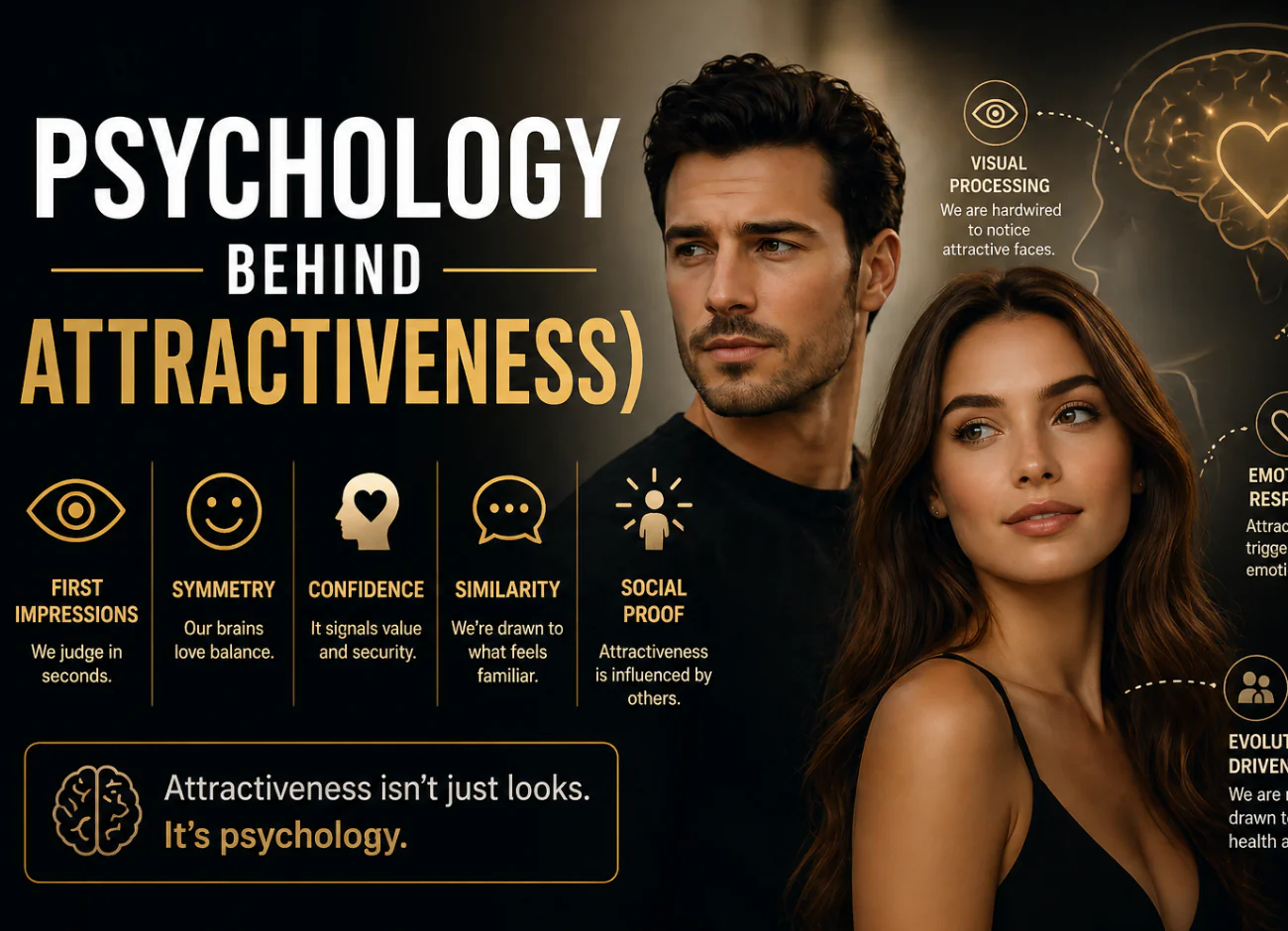
It has nothing to do with looks. It never really did. (How your Brain Chooses Your Crush)

You have seen it happen. A guy who would never win a beauty contest walks into a room and somehow walks out with the most interesting woman in it. Meanwhile, someone objectively handsome stands nearby, confused, holding his drink.
It seems to make no sense. Until you understand how attraction actually works — not as a feeling, but as a biological process shaped by millions of years of evolution and some very specific differences in how male and female brains are wired.
Once you see it, you cannot unsee it.
Men and Women Are Not Attracted the Same Way — At All
This is the starting point, and it is more important than most people realize.
When a man sees an attractive woman, something happens in his brain almost instantly — within about 150 milliseconds. His visual cortex fires. His amygdala lights up. His nucleus accumbens — the same region involved in addiction — floods with dopamine. His hypothalamus releases a small surge of testosterone. His whole system is essentially saying: approach, now.
It is fast. It is emotional. It is almost entirely beyond his conscious control. Researchers have compared this response to the early stages of addiction, which explains why male attraction can feel so overwhelming and immediate.
Female attraction works almost nothing like this.
When a woman sees a man — even a conventionally attractive one — her brain does not produce the same cascade. The amygdala activates only mildly. There is no significant dopamine spike. Instead, the prefrontal cortex engages almost immediately. This is the part of the brain responsible for rational evaluation, long-term thinking, and judgment.
In other words, a woman’s brain does not fall for someone. It begins quietly interviewing them.
The Numbers Tell the Story
Consider what happens on dating apps, where attraction is measured in its most raw, unfiltered form.
Studies show that men swipe right on roughly 35% of female profiles. Women swipe right on around 4% of male profiles. This is not a cultural quirk. This pattern holds across countries, cultures, and age groups.
Women are not being difficult. They are being exactly what evolution made them — cautious, evaluative, and focused on long-term value rather than immediate visual appeal.
Why Evolution Made Women This Way
To understand why female attraction works the way it does, you have to go back — a long way back.
Around one to two million years ago, early female hominids chose mates in a fairly straightforward way. Physical dominance and strength signaled good genes and protection. The process was relatively simple.
Then something changed. Humans began walking upright. Bipedalism narrowed the pelvis, which created a problem: bigger brains meant bigger heads, but the birth canal was getting smaller. The evolutionary solution was to deliver babies earlier — before their heads grew too large to pass through safely.
The result was that human babies were born extraordinarily helpless compared to other animals. A foal can walk within hours of birth. A human infant cannot do anything useful for years. This meant a mother needed a partner who would stay, protect, provide, and cooperate — not just someone who looked impressive for a moment.
Female mate selection had to get much more sophisticated. Over the next two million years, it did.
Women’s brains evolved to evaluate not just physical fitness but resourcefulness, intelligence, social status, loyalty, and the ability to function within a group. The question was no longer just “is he strong?” It became something more like “will he still be here in ten years?”
What Women Are Actually Evaluating
When a woman meets a man and feels that slow-building curiosity — that sense that something is interesting about him — what is actually happening in her brain?
Her prefrontal cortex is gathering data. It is processing dozens of signals simultaneously, most of them below the level of conscious awareness.
Confidence is the biggest one. Not arrogance — they are very different things, and the female brain distinguishes between them quickly. Genuine confidence signals that a man knows his own value, can handle social pressure, and is unlikely to be destabilized by the inevitable difficulties of life. That is useful information for someone evaluating a long-term partner.
Social status matters too. How does he move through a room? Do others listen when he speaks? Does he seem comfortable or anxious? These are not shallow concerns. They are ancient survival calculations dressed in modern clothes.
Then there is how he treats people — small moments of kindness, humor, the way he handles embarrassment or conflict. Women pick up on these things with a level of detail that often surprises men who have not thought about it.
Looks register, but they register later, and they are easily overridden. A man who is conventionally attractive but behaves with uncertainty, neediness, or disrespect loses his advantage almost immediately. A man who is unremarkable in appearance but moves through the world with ease, genuine warmth, and self-possession starts to look very different after twenty minutes of conversation.
The Slow Burn Is Not a Mystery — It Is Biology
Here is something that confuses a lot of men: a woman might meet someone and feel relatively neutral about him. Then, weeks later, she is completely invested. Nothing obvious changed. What happened?
Her emotional brain caught up with her rational brain.
Early attraction in women is largely a prefrontal cortex process — cool, evaluative, somewhat detached. But as trust builds, as positive experiences accumulate, as a man continues to demonstrate the qualities her brain was originally scanning for, the emotional regions begin to activate. The amygdala starts to contribute. Oxytocin and dopamine enter the picture.
This is why women often describe attraction as something that “grew over time” rather than struck like lightning. It is not a malfunction or a contradiction. It is the system working exactly as it was designed to.
It also explains something less comfortable: once a woman has fully bonded emotionally, that attachment can persist even when rational signals suggest it should not. The emotional brain does not let go easily. This is the same architecture that made early human mothers willing to sacrifice everything for a helpless infant — applied now to a partner.
The Confidence Feedback Loop
There is one more piece worth understanding, especially for younger men trying to make sense of school or college social dynamics.
Attractive boys tend to receive more positive social feedback from an early age. People smile at them more. They get more attention. Over years, this creates genuine confidence — not because they did anything particular to earn it, but because the world responded to them warmly and they internalized that response.
So when women are attracted to the confident, socially easy boy rather than the quieter, more conventionally awkward one, they are not always responding to looks. They are often responding to the behavior that looks happened to produce.
This matters because confidence is not actually tied to appearance. It can be built, practiced, and developed independently. Men who understand this stop trying to change their face and start working on the thing that actually moves the needle.
What This Actually Means
The science here is not particularly complicated once you step back and look at it whole.
Women evolved to be careful. They had more to lose from a bad choice — in time, in energy, in risk — and their brains reflect that. The result is an attraction system that is slower, more rational, more socially sensitive, and ultimately more complex than the visual-first system most men operate on.
This is not a hierarchy. Neither system is better. They are different solutions to different evolutionary problems. Men needed to identify fertile mates quickly in a competitive environment. Women needed to identify reliable partners in a world where reliability was a matter of survival.
The man who walks into a room and captures attention without being the best-looking person there is not doing something magical. He is simply demonstrating, through confidence and social ease and genuine warmth, that he is worth paying attention to. And the female brain — scanning constantly, evaluating quietly — notices.
Looks open a door, maybe. But they have almost nothing to do with whether anyone wants to stay once they step through it.
The Takeaway
If you take one thing from everything above, let it be this: attraction is not a mystery to be decoded or a game to be won. It is a biological process, shaped over millions of years, that responds to very real and very learnable qualities — confidence, presence, warmth, social intelligence, and the ability to make another person feel genuinely seen.
Those things are available to anyone willing to develop them. Cheekbones are not. For More Click Here