
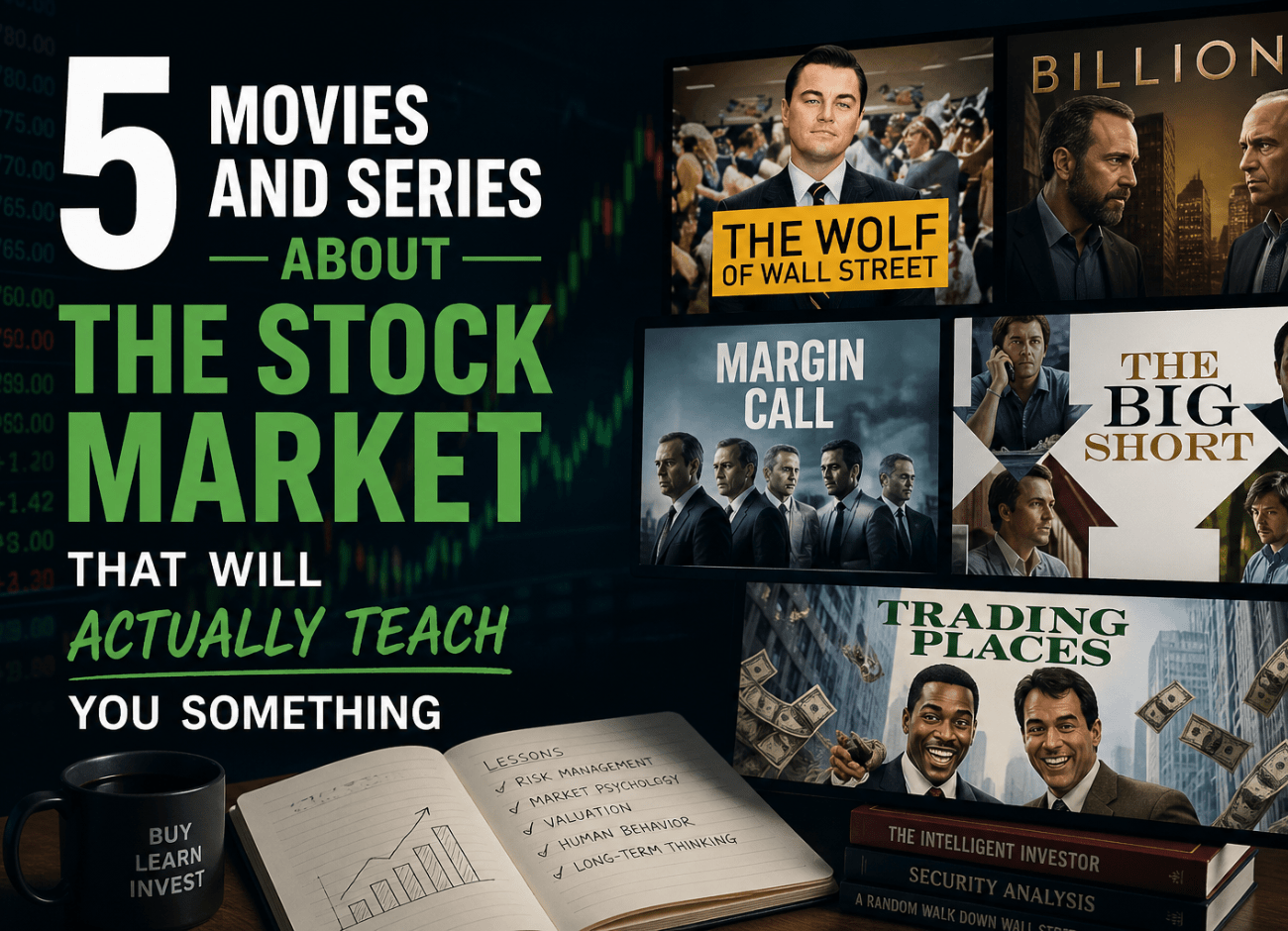
These are not just entertaining. Watch them carefully and you will understand money, greed, and markets better than most people with a finance degree.
There is a certain kind of film that does something rare — it makes you feel the rush of a market rally, the cold dread of a crash, and the slow unraveling of someone who thought they had figured out the game. Stock market movies, when they are done well, are not really about money. They are about human nature. About ambition, delusion, genius, and the very thin line between all four.
Whether you are a complete beginner curious about how markets work, or someone who already trades and wants to see the psychology of it reflected back at you — this list has something worth your time.
Here are the best films and series on stock markets and business, ranked — plus a few additions that deserve far more attention than they get.
No. 5 — Too Big to Fail (2011)
IMDb: 7.3 | Available on: Disney+ Hotstar | Language: English
Most people know the 2008 financial crisis happened. Very few understand how close the entire global financial system came to a complete and irreversible collapse — not over months, but over a matter of days.
Too Big to Fail puts you inside the rooms where those decisions were being made. Treasury secretaries, bank CEOs, Federal Reserve officials, all scrambling to prevent something that had never happened before and for which there was no real playbook. The film is based on Andrew Ross Sorkin’s deeply researched book of the same name, and it has the rare quality of making regulatory finance genuinely tense.
What you learn watching this is not just what went wrong in 2008. You learn how interconnected financial institutions actually are — how the failure of one triggers the next, and how the people trusted with preventing catastrophe are often improvising under pressure just like everyone else.
“The most dangerous phrase in finance is ‘this time it is different.’ It never is.”
Watch it if: You want to understand what systemic risk actually means, not just as a textbook term but as a lived emergency.
No. 4 — The Big Short (2015)
IMDb: 7.8 | Available on: Amazon Prime | Language: English
This film does something almost no financial movie has managed before or since — it makes the mechanics of a credit default swap genuinely interesting. Director Adam McKay breaks the fourth wall, uses celebrity cameos to explain complex financial instruments, and somehow turns the story of a handful of eccentric investors betting against the American housing market into one of the most entertaining films of its decade.
But underneath the clever presentation is something worth sitting with. The people at the center of this story saw the crash coming. They had the data. They tried to tell people. Nobody listened — not because the information was unavailable, but because the system had every incentive to keep pretending everything was fine.
The Big Short is a film about willful blindness. About how institutions, regulators, and individuals all chose comfort over truth until the truth became impossible to ignore. That dynamic did not end in 2008. It is running somewhere right now.
“It ain’t what you don’t know that gets you into trouble. It’s what you know for sure that just ain’t so.” — Mark Twain, quoted in the film’s opening
Watch it if: You have some basic financial knowledge and want to understand how sophisticated investors think — and how entire markets can be wrong.
No. 3 — The Wolf of Wall Street (2013)
IMDb: 8.2 | Available on: MX Player (Free in India) | Language: Hindi and English
Three hours long. Not a single wasted scene.
Martin Scorsese’s film based on Jordan Belfort’s memoir is one of the most polarizing films about money ever made — because it does not moralize. It does not punish its protagonist on screen and then explain why what he did was wrong. It simply shows you the life: the excess, the manipulation, the extraordinary ability to sell, and the slow erosion of every boundary that once existed.
Leonardo DiCaprio’s Belfort is magnetic in a way that is genuinely uncomfortable. You understand why people followed him. You understand why the money felt real and the harm felt abstract. And that discomfort is the film’s actual lesson — that charisma and criminality are not opposites, that the skills that make someone brilliant at sales are sometimes the same skills that make them dangerous.
Belfort’s actual scheme — selling worthless penny stocks to ordinary investors while taking enormous hidden commissions — is explained clearly enough that you will never look at a cold call the same way again.
Watch it if: You want to understand the psychology of salesmanship, market manipulation, and why smart people make catastrophic decisions.
No. 2 — Billions (2016 — Ongoing)
IMDb: 8.4 | Available on: Disney+ Hotstar | Language: English | Seasons: 6+
Television rarely handles the world of hedge funds and financial power with real sophistication. Billions is the exception.
The central tension of the show — a brilliant, aggressive hedge fund manager against a equally ambitious federal prosecutor — is essentially a chess match played with billions of dollars, political capital, and personal relationships as the pieces. What makes Billions remarkable is that neither side is simply right or wrong. Both are brilliant. Both cross lines. Both believe completely in their own justifications.
From a learning perspective, Billions is dense with actual concepts — risk management, regulatory strategy, insider information laws, fund structure, trader psychology. It does not explain these for beginners. It assumes you will either keep up or catch up. That respect for the audience’s intelligence is part of what makes it so rewarding.
“The person who fights for everything wins nothing. You have to decide what you actually want and go get that.” — Axe, Billions
Watch it if: You are serious about understanding how money, power, and institutional finance actually operate — and you want six seasons of it.
No. 1 — Scam 1992 (2020)
IMDb: 9.6 | Available on: SonyLIV | Language: Hindi
Nothing else on this list comes close in terms of its impact on how an entire generation of Indians thought about the stock market.
Scam 1992 tells the story of Harshad Mehta — a man from an ordinary background who understood the Indian banking system better than the people running it, used that understanding to execute one of the largest market manipulations in Indian financial history, and eventually lost everything in the most public collapse imaginable.
What makes the series extraordinary is its refusal to flatten Harshad into either a villain or a hero. He is shown as genuinely brilliant — his grasp of how money moves between institutions was real and sophisticated. He is also shown as someone whose ambition outgrew his ethics, who crossed lines and then convinced himself the lines were in the wrong place to begin with.
For Indian viewers specifically, the series does something no textbook has managed — it makes the mechanics of the Bombay Stock Exchange, banking receipts, and inter-bank lending genuinely understandable and genuinely dramatic. Millions of people opened demat accounts after watching this series. That is a remarkable thing for a television show to have achieved.
“Risk hai toh ishq hai.” — Harshad Mehta, Scam 1992 (If there is risk, there is love.)
Watch it if: You want to understand Indian financial markets, the psychology of a market genius, and what happens when brilliance operates without limits.
3 More That Deserve Your Time
The original list covers the essentials. But these three are worth adding — each one teaches something the others do not.
Margin Call (2011)
IMDb: 7.1 | Language: English
This film takes place over a single night at a fictional investment bank — the night a young analyst discovers that the firm’s positions have become so large and so toxic that they face total collapse by morning. What follows is a series of conversations between people at different levels of the organisation, each one managing information, responsibility, and their own survival differently.
Margin Call is quiet, dialogue-driven, and almost entirely devoid of action. It is also one of the most accurate portrayals of how financial institutions actually function under pressure — how decisions get made, how accountability gets diffused, and how people who are not individually evil can collectively produce catastrophic outcomes.
Jeremy Irons plays the CEO with a chilling combination of genuine intelligence and complete moral detachment. The scene where he explains his philosophy about financial crises is worth watching twice.
“Be first, be smarter, or cheat.” — John Tuld, Margin Call
Rogue Trader (1999)
IMDb: 6.5 | Language: English
Nick Leeson was a derivatives trader at Barings Bank — one of Britain’s oldest and most prestigious financial institutions. In 1995, he single-handedly caused its collapse through a series of unauthorized trades hidden in an error account he controlled.
The film based on his story is not technically polished and the production is dated. But the story it tells is important and instructive in ways that more glamorous films miss. Leeson was not a criminal genius. He was someone who made a mistake, hid it, made bigger trades to cover the mistake, hid those too, and kept going until the numbers were too large to survive.
It is a story about loss aversion — the psychological trap of refusing to accept a loss and instead doubling down until the loss becomes catastrophic. Every trader and investor needs to understand this pattern because it does not require dishonesty to trigger. It only requires being human.
Inside Job (2010)
IMDb: 8.2 | Available on: Various streaming platforms | Language: English
Technically a documentary, not a film — but it belongs on this list because it is the single most complete explanation of the 2008 financial crisis ever put on screen.
Director Charles Ferguson spent years interviewing the economists, regulators, bankers, and politicians involved in creating and then failing to prevent the crisis. The result is a film that is methodical, devastating, and consistently infuriating. It traces exactly how financial deregulation, academic conflicts of interest, regulatory capture, and Wall Street’s political influence combined to create conditions for a collapse that was, in hindsight, almost inevitable.
Inside Job won the Academy Award for Best Documentary. More importantly, it will permanently change how you read financial news, interpret economic policy debates, and think about who actually benefits when markets move.
“The financial industry has essentially captured our government.” — Inside Job
How to Actually Watch These
A suggestion worth offering: do not watch these passively. Keep your phone nearby — not to scroll, but to search. When a term comes up you do not understand, look it up immediately. When a real event is referenced, read about it. When a character makes a decision that seems inexplicable, pause and think about what you would have done.
The best financial education available is not expensive. It is sitting in these films, waiting for the viewer who pays attention.
| Title | Type | IMDb | Best For |
|---|---|---|---|
| Scam 1992 | Series | 9.6 | Indian market understanding |
| Billions | Series | 8.4 | Hedge fund and risk strategy |
| The Wolf of Wall Street | Film | 8.2 | Sales psychology and market manipulation |
| Inside Job | Documentary | 8.2 | 2008 crisis — the full picture |
| The Big Short | Film | 7.8 | Short selling and systemic risk |
| Too Big to Fail | Film | 7.3 | Banking crisis decision-making |
| Margin Call | Film | 7.1 | Institutional decision-making under pressure |
| Rogue Trader | Film | 6.5 | Individual psychology and loss aversion |
Watch one. Then watch another. By the time you finish the list, you will think about money differently — and that is probably the most valuable thing any film can do. For more info click here