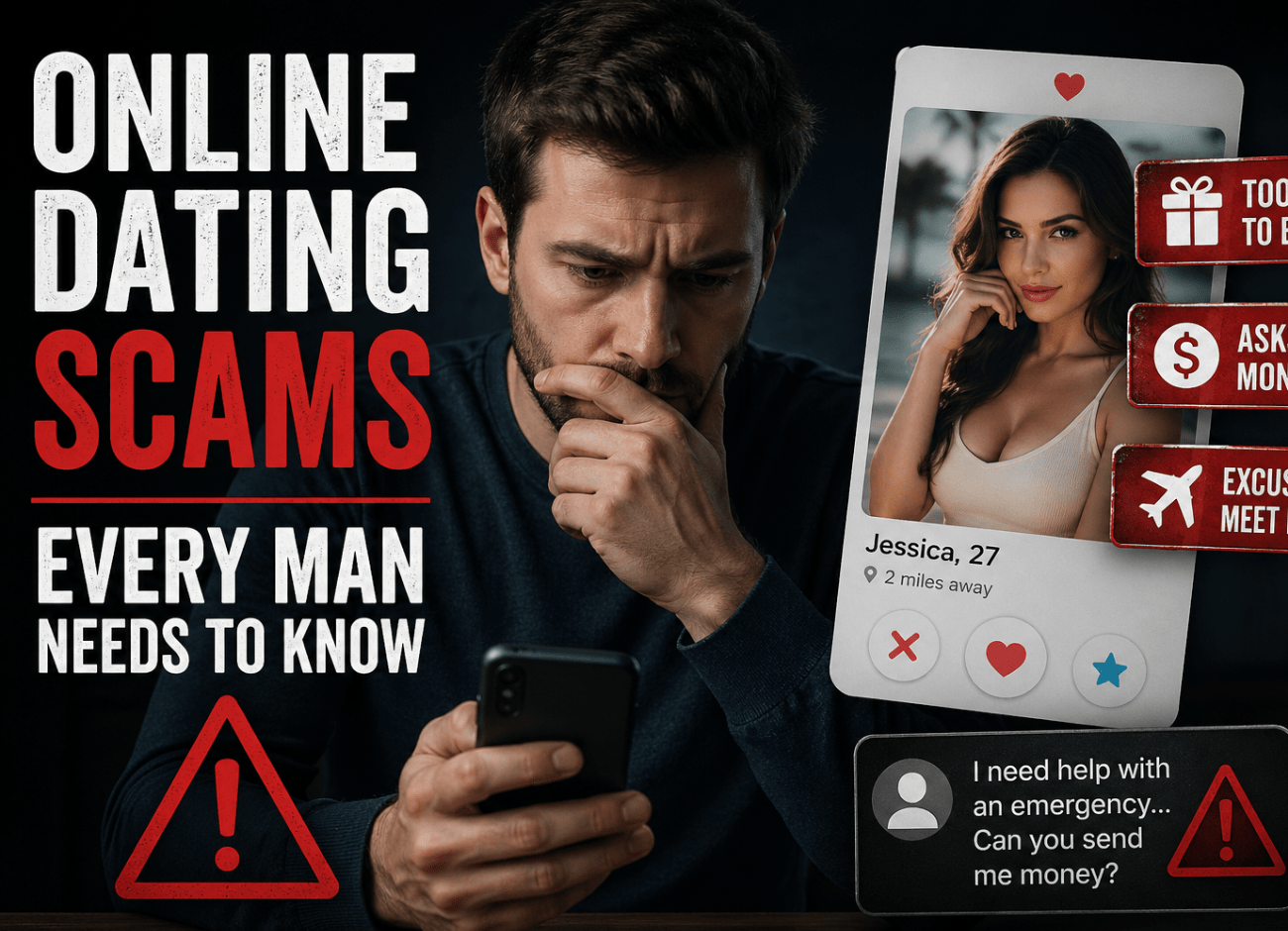
Real stories. Real money lost. And the exact tactics being used so you can spot them before it is too late. (5 Online Dating Scams Every Man Needs To Know)
He thought he had finally met someone special.
Ravi, a 28-year-old software engineer from Bangalore, matched with a woman on a popular dating app. She was attractive, spoke fluent English, and seemed genuinely interested in him. Within days, she told him she was flying to India to meet him. Then came the message he did not see coming — she was stuck at customs, her bags were held, and she needed ₹20,000 to clear the fees. Just this once. She would pay him back the moment she landed.
He sent the money. Then she needed more. Then more again. She never landed. She never existed.
Ravi’s story is not unique. It is not even particularly unusual anymore.
The Landscape Has Changed
Online dating used to feel risky in the way that meeting a stranger always feels risky — a little uncertain, a little unpredictable, but manageable. That era is largely over. What has replaced it, in India and across the world, is something more organized, more sophisticated, and significantly more dangerous.
Dating app scams in India have evolved from clumsy, obvious schemes into coordinated operations run by what investigators increasingly describe as scam networks — groups of people who divide labor, share scripts, operate fake locations, and sometimes involve corrupt or impersonating law enforcement. Victims are not random. They are profiled, studied, and approached at their most emotionally vulnerable.
The people losing money are not naive or foolish. They are doctors, engineers, business owners, and students. They are people who considered themselves reasonably careful. Understanding how these scams work — mechanically, step by step — is the only real protection against them.
Five Real Cases. Five Different Traps.
These stories are drawn from documented accounts of victims across Indian cities. The names have been kept as reported. The details are real.
Case 1 — The Foreign Girl Who Never Arrived
“She had a profile picture, she had a backstory, she had a reason for everything. The only thing she did not have was any intention of meeting me.” — Ravi, 28, Bangalore
Ravi matched with a woman presenting herself as a foreign national visiting India. The conversation was warm, consistent, and felt genuine over several days. Then she announced she was on her way — and then the customs emergency arrived.
The ₹20,000 became ₹40,000. Each payment came with a fresh crisis. Eventually, the requests became so relentless that the illusion cracked. Ravi stopped sending money and blocked the account.
What was actually happening: This is called the “airport customs scam” — one of the oldest formats in the playbook, now updated for dating apps. The “woman” is typically a team of people using stolen photos, a rehearsed script, and a shared phone. They run dozens of these simultaneously. Most victims feel too embarrassed to report it.
What Ravi lost: Approximately ₹40,000 before he pulled out.
Case 2 — The Café That Cost ₹54,000
“I thought I was going on a date. I did not realize I had walked into someone’s business plan.” — Nikhil, 25, Delhi
Nikhil met a woman at a metro station — a real, in-person meeting after chatting online. She seemed genuine. She suggested a café he had never heard of, in a lane he did not know. The drinks were expensive but he was trying to make a good impression.
Then her phone rang. A family emergency, she said. She had to leave immediately. She was so sorry. He said he would handle the bill.
The bill was ₹54,000.
When he protested, staff members who were not exactly staff members made it very clear he was not leaving without paying. He paid. He was scared. He later learned the café was one of several operated by an organized network specifically for this purpose.
What was actually happening: This is a “bar tab scam” with organized crime infrastructure behind it. The woman is an employee. The café is the trap. The “family emergency” is the exit cue. This operation requires coordination between the woman, the venue, and the people who enforce payment.
What Nikhil lost: ₹54,000 in a single evening.
Case 3 — The Pregnancy That Never Was
Rahul met a woman through a dating app, and after a date that turned intimate, he received a photo the next morning — a pregnancy test, positive, with a demand for money to “handle it quietly.”
The photo was fake. The test was staged. The threat of going to the police if he did not pay was the real instrument of control.
He paid. Out of panic, out of embarrassment, out of not knowing what else to do.
What was actually happening: This scam exploits shame and fear of social exposure in ways that are particularly effective in contexts where family reputation carries enormous weight. The victim is targeted specifically because they are unlikely to involve family or friends — which means they are unlikely to get a reality check before paying.
The critical insight: A single consensual encounter cannot result in a credible criminal case. The threat has almost no legal foundation. But fear rarely responds to logic in the moment.
Case 4 — The Photos That Became Weapons
“I trusted her. That was the mistake. Once those photos existed, I had no control over anything.” — Vishal, 32, Gurgaon
Vishal connected with someone online and, over several weeks of conversation, the relationship became intimate digitally. He shared private photos. She shared what appeared to be private photos in return.
Then the tone changed completely. Pay ₹30,000 or the photos go to your contacts, your family, your employer. He paid. The demand came again. He paid again. ₹25,000. Then ₹15,000 more. The demands had no end point because there was never going to be one.
What was actually happening: Sextortion is now one of the fastest-growing forms of online fraud in India. The “woman” in many of these cases is a man using stolen photos. The operation is often run from another state or even another country. The photos shared “in return” are stock images or images stolen from other victims.
What Vishal lost: Over ₹70,000, and months of severe psychological distress.
Case 5 — The Fake Police Raid
Ashish met a woman online, they met in person, and eventually he visited what she described as her home — with a friend of hers present. Shortly after arriving, two men in police uniforms entered the flat.
They accused him of being involved in something illegal. They confiscated his phone. They demanded he transfer money immediately to avoid arrest. Disoriented, frightened, and isolated in an unfamiliar place, he transferred ₹70,000 from his bank accounts before managing to get out.
What was actually happening: This is the most physically dangerous variant of dating scams — a coordinated robbery using the authority of law enforcement as cover. The “police officers” were not police officers. The flat was a controlled environment chosen specifically because victims feel trapped and cannot easily call for help.
What Ashish lost: ₹73,000 approximately, plus his phone, plus a level of personal safety violation that money cannot really measure.
How Every Scam Follows the Same Invisible Script
Different stories, different cities, different amounts of money — but look closely and the structure is almost identical every time.
| Phase | What the Scammer Does | What the Victim Feels |
|---|---|---|
| Initial contact | Flattery, forward communication, fast intimacy | Flattered, excited, hopeful |
| Building trust | Consistent attention, shared photos, future plans | Emotionally invested |
| First meeting or escalation | Either in-person trap or digital intimacy | Comfortable, off-guard |
| The demand | Emergency, threat, or blackmail introduced | Shocked, confused, scared |
| Escalation | Repeated demands with increasing pressure | Trapped, ashamed, isolated |
| Exit | Victim pays until they stop or run out of money | Financially damaged, emotionally exhausted |
The reason this script works so consistently is that it targets something real — the human desire for connection — and uses it as a vulnerability. The scammers are not guessing. They have refined these approaches over thousands of attempts.
What Actually Protects You
Safety advice about online dating tends to be vague. Here is what is specific, practical, and actually effective.
Verify before you trust. Search the profile photos in reverse image search. Cross-check on Instagram and Facebook. Look for mutual connections. A real person leaves a real trail. Scam profiles are often thin — few posts, recent account creation, photos that seem slightly mismatched in age or style.
The location of the first meeting is everything. Only meet in places that are genuinely public — busy cafés with fixed, visible menus, well-known restaurant chains, places with staff you can approach. Never go somewhere suggested by someone you have just met online, especially if it is unfamiliar to you. If they push back on your location choice, that is information.
A scammer’s most powerful tool is an environment they control. Remove that and you remove most of the risk.
Tell someone where you are going. Share your live location with a friend before you leave. Agree on check-in times. Establish a code word that means “call me with an emergency.” This is not paranoia — it is the same logic as wearing a seatbelt. You do not expect to need it. You wear it anyway.
Never share intimate photos with someone you have not met in person and known for a significant period of time. This point deserves more directness than it usually gets. Once an image exists on someone else’s device, you have no control over it. None. The risk is permanent and the consequences can be severe.
If someone demands money, do not pay. This is the hardest advice to follow in the moment, but it is the most important. Payment does not end the problem — it confirms that the pressure works and invites more pressure. If you are being threatened, call someone you trust immediately. Contact cybercrime authorities. The embarrassment of reporting is temporary. The damage of continued extortion is not.
Keep your financial exposure minimal. When meeting someone for the first time, carry limited cash. Do not have your primary banking app on an accessible device. If someone takes your phone, the amount they can access should be as small as possible.
The Bigger Problem Nobody Talks About
Most of these scams go unreported.
Victims stay quiet because they feel ashamed — of being fooled, of having been intimate with someone, of having done something their family would not approve of. The scammers know this. Shame is as much a part of the business model as the fake profile.
India’s cybercrime reporting infrastructure has improved, but awareness of it remains low. The National Cyber Crime Reporting Portal at cybercrime.gov.in exists specifically for cases like these. Local cybercrime cells in most major cities have seen enough of these cases to handle them without judgment.
Reporting matters not just for the individual victim but because these networks operate at scale. Each report is a data point. Enough data points eventually builds a picture that law enforcement can act on.
A Final Thought
Online dating is not inherently dangerous. Millions of people use it every day without incident, and genuine connections form on these platforms all the time. The goal is not to avoid it — the goal is to approach it the way you would approach anything that involves trust between strangers: carefully, with your eyes open, and without letting hope override judgment.
The scammers are counting on the fact that you want to believe. That the profile is real, that the connection is genuine, that this time it is different.
Go slowly. Verify everything. Meet in public. Tell someone where you are.
And if something feels wrong — if the conversation is moving too fast, if the requests are arriving too soon, if something does not quite add up — trust that feeling. It has probably already figured out what your optimism has not yet accepted.
“The best protection against a scam is the pause before you act. Scammers are always creating urgency. Genuine people never need you to decide in the next five minutes.”
If you or someone you know has been a victim of an online dating scam in India, report it at cybercrime.gov.in or call the national cybercrime helpline at 1930. You are not alone, and reporting is the first step toward recovery and preventing others from experiencing the same.
Thanku For Visiting Aviralinfo.co.in