
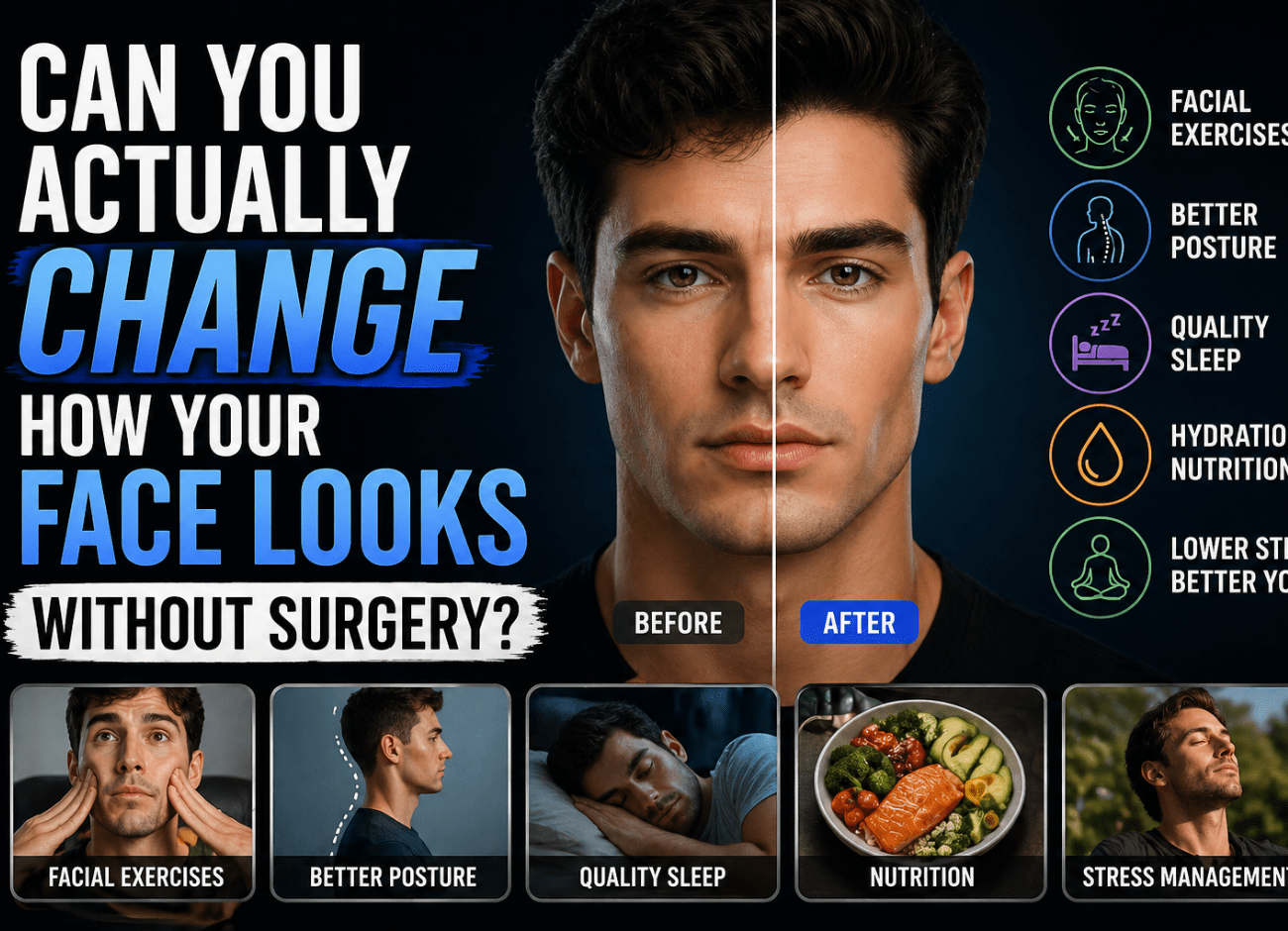
The answer is more interesting — and more honest — than most people expect.
Every few years, something surfaces online that promises to reshape your face without a scalpel. Right now, that thing is mewing. Thousands of before-and-after photos. Countless YouTube tutorials. Teenagers doing it religiously. Adults trying it skeptically.
But is there anything real behind it? And more broadly — what actually determines how attractive a face looks, and how much of that can you genuinely influence?
The science here is more nuanced than either the true believers or the dismissers tend to admit. Let’s go through it properly.
First, What Makes a Face Attractive in the First Place?
Before talking about changing your face, it helps to understand what attractiveness actually is — because it turns out to be less mysterious than most people think.
Researchers have identified two features that consistently predict how attractive a face is rated across different cultures and age groups. These are not arbitrary preferences. They are instincts shaped by millions of years of evolution.
The first is facial proportion. Faces that are close to the statistical average of human faces — not extreme in any particular feature — tend to be rated as more attractive. A nose that is unusually large, eyes that are set unusually wide, a jaw that is dramatically undersized — any strong deviation from average tends to reduce attractiveness ratings. This is not about being bland. It is about signaling, at a biological level, that development went normally and the genes are sound.
The second is symmetry. A symmetrical face suggests that the body had the genetic resources and the developmental stability to build both sides correctly, without interference from illness, stress, or poor nutrition during growth. Studies where researchers show people both the original photo of a face and a digitally symmetrized version consistently find the symmetrical version rated as more attractive — even when people cannot consciously identify what changed.
These two things — proportion and symmetry — are the foundation. Everything else builds on them.
What Is Genetic and What Is Not?
Here is where it gets genuinely interesting, because the face is not a single thing when it comes to how fixed it is.
The upper half of your face — the distance between your eyes, the shape of your brow, the structure of your forehead — is almost entirely determined by genetics. There is not much you can do about it, and you probably should not try.
The lower half is a different story. Your jawline, your chin definition, the overall structure of the lower face — these are meaningfully shaped by external factors. Specifically, by breathing patterns, tongue posture, and the mechanical forces your face is subjected to during the years when bone is still growing and adapting.
This is not fringe science. Orthodontists and oral-maxillofacial surgeons have known for decades that how you use your mouth affects how your jaw develops. The question is how much you can influence it deliberately, and at what age.
What Is Mewing, and Is It Real?
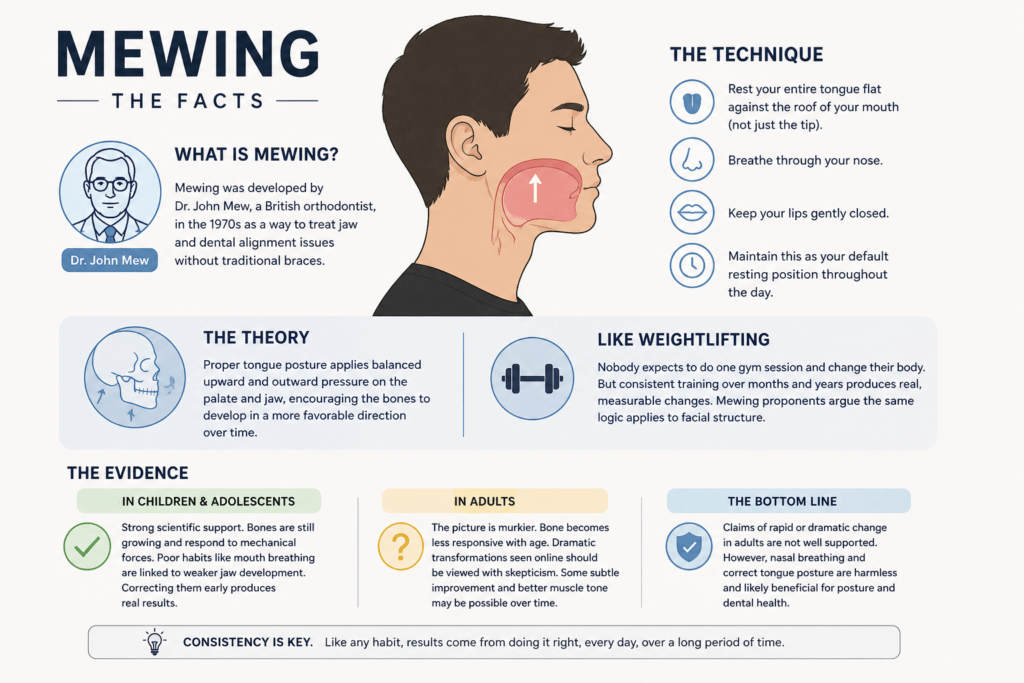
Mewing was developed by a British orthodontist named Dr. John Mew, who introduced the idea in the 1970s as a way to treat jaw and dental alignment issues without traditional braces.
The technique itself is simple to describe. You rest your entire tongue flat against the roof of your mouth — not just the tip, but the whole tongue making full contact with the palate. You breathe through your nose. You keep your lips gently closed. You maintain this as your default resting position throughout the day.
The theory is that proper tongue posture applies balanced upward and outward pressure on the palate and jaw, encouraging the bones to develop in a more favorable direction over time. Think of it like braces — not a dramatic intervention, but consistent gentle force applied over a long period.
The comparison to weightlifting is useful here. Nobody expects to do one gym session and change their body. But consistent training over months and years produces real, measurable changes. Mewing proponents argue the same logic applies to facial structure.
Here is the honest assessment of the evidence. In children and adolescents, whose bones are still actively growing and reshaping in response to mechanical forces, there is genuine scientific support for the idea that tongue posture and breathing habits influence jaw development. This is not controversial in orthodontics. Mouth breathing in children is associated with weaker jaw development, more protruding teeth, and poorer facial posture. Correcting it early produces real results.
In adults, the picture is murkier. Bone becomes less responsive to mechanical forces as we age. The dramatic jawline transformations you see in before-and-after posts online should be viewed with significant skepticism. That said, some subtle structural improvement and better muscle tone around the jaw and neck may be achievable over time. The claims of rapid or dramatic change in adults are not well supported. The basic practice of nasal breathing and correct tongue posture is harmless and likely beneficial for posture and dental health regardless.
The Mouth Breathing Problem Nobody Talks About Enough
Separate from mewing as an active practice, there is a passive issue worth understanding: what mouth breathing does to your face over time.
When the mouth hangs open as a default resting position — whether due to habit, nasal congestion, or structural issues — the tongue rests low in the mouth rather than against the palate. This removes the upward pressure on the jaw and palate that proper tongue posture provides.
Over years, especially during childhood development, this tends to produce a recognizable set of changes. The jaw grows more downward than forward. The chin recedes. The teeth may protrude. The neck posture shifts forward to compensate, creating a head-forward position that affects the entire profile.
None of this is destiny. But if you are a mouth breather, addressing that habit — through whatever means works for your situation — is likely the single highest-leverage thing you can do for your facial structure over time.
How to Actually Do the Tongue Posture Correctly
For those who want to try the basic practice, the technique has three components.
Start by finding the right tongue position. Make the sound “N” and hold it — your tongue tip should be resting just behind your upper front teeth. That is the starting point. From there, try to get the body of your tongue to make full contact with the roof of your mouth.
With your tongue in that position, close your lips gently without clenching your teeth. Swallow normally — this naturally creates a light suction that helps maintain the position.
Finally, tuck your chin very slightly backward. Most people carry their head slightly forward, which weakens the appearance of the jawline and creates neck tension. A small correction here, combined with the tongue posture, improves the entire profile.
The goal is to make this your unconscious resting position throughout the day. It takes time to retrain a habit, but most people notice that their posture and neck tension improve within weeks even if facial structure takes much longer.
What Else Actually Works?
Beyond tongue posture, there are other factors that have solid evidence behind them.
Body fat percentage is probably the most immediately impactful. The face stores and loses fat like every other part of the body, and facial definition — the visibility of the jawline, the sharpness of cheekbones — is heavily influenced by overall body fat. A University of Toronto study found that the most attractive facial appearances in men corresponded to a BMI around 24, and in women around 19. These are ranges where there is enough healthy fat to look youthful but not so much that definition is lost.
This is worth emphasizing because it is both the most actionable variable and the most often overlooked. People spend enormous energy researching jawline exercises while carrying excess body fat that obscures whatever structure they have. Losing fat will do more for your jawline than almost anything else, and it has the advantage of actually being proven.
Jaw muscle exercises also contribute modestly. The masseter muscles — the muscles you use for chewing — sit along the side of the jaw and contribute to jawline definition when developed. Chewing tougher foods, like raw vegetables, or using chewing gum consistently can build these muscles over time. The effect is real but subtle, and it takes months of consistency to notice.
Neck exercises — specifically neck crunches and chin tucks — strengthen the muscles that frame the jaw from below, creating a cleaner transition between the face and neck. This matters more than most people realize for overall profile appearance. Avoid heavy weighted neck exercises though, as the injury risk outweighs the cosmetic benefit.
For men, a well-maintained beard is worth mentioning as a practical and immediate tool. A beard adds definition to the lower face, can minimize the appearance of a receding chin, and shifts proportions in a favorable direction. Virat Kohli is a frequently cited example — someone whose face reads as significantly more attractive with a beard than without, largely because it adds lower face definition and balances his proportions.
The Sexual Dimorphism Factor
One more concept worth understanding is sexual dimorphism — the degree to which a face expresses distinctly male or female characteristics.
In men, features like a strong jawline, prominent brow, and broader facial structure signal testosterone and physical maturity. In women, features like fuller lips, softer facial contours, and higher cheekbones signal estrogen and reproductive health. People are instinctively drawn to faces that clearly express these sex-specific characteristics.
Importantly, more is not always better. The research shows an “uncanny valley” effect at the extremes — faces that are dramatically exaggerated in their masculine or feminine features start to look artificial or even unsettling. The attractive range sits in a zone that is clearly genetically healthy and sexually mature without being cartoon-like.
This is relevant for anyone considering cosmetic interventions. Subtle enhancement of natural features tends to improve attractiveness. Dramatic alteration that pushes features to extremes often does the opposite.
The Honest Summary
Here is what the evidence actually supports.
Your bone structure is partly genetic and partly shaped by habits — especially breathing habits during growth years. If you are young, correcting mouth breathing and maintaining proper tongue posture has real, documented effects on jaw development. If you are an adult, the effects are slower and more modest, but nasal breathing and good posture are worth developing for reasons well beyond facial aesthetics.
Reducing body fat is the highest-leverage action available to most people for improving facial definition. It works, it is measurable, and the results are visible.
Jaw and neck exercises produce modest improvements in muscle tone and definition over time. They are worth doing as part of general fitness, not as a miracle solution.
And throughout all of this — the same thing keeps coming up in the research. Confidence and the way a person carries themselves consistently override physical features in how attractive they are perceived to be. A well-defined jaw on someone who moves through the world with anxiety and self-doubt is less compelling than an ordinary face on someone who seems genuinely comfortable in their own skin.
The face is worth taking care of. It is just not the whole story.
This article is for informational purposes only. Claims about adult facial restructuring through mewing lack comprehensive scientific backing and should be interpreted cautiously. Always consult a qualified medical professional before making changes to address dental or jaw concerns.
Thanku For Visiting Aviralinfo.co.in