The thing that’s destroying you isn’t what happened. It’s what you keep doing after.
Imagine getting a small cut on your hand. It stings, sure – but it’s minor. Now imagine spending the next three days hitting that same hand against a wall, over and over, because you’re so angry about the cut.
By day three, the original cut is the least of your problems.
That sounds absurd, right? And yet, most of us do exactly this – emotionally. Something hurts us. And then, through our reaction to that hurt, we hurt ourselves far, far worse.
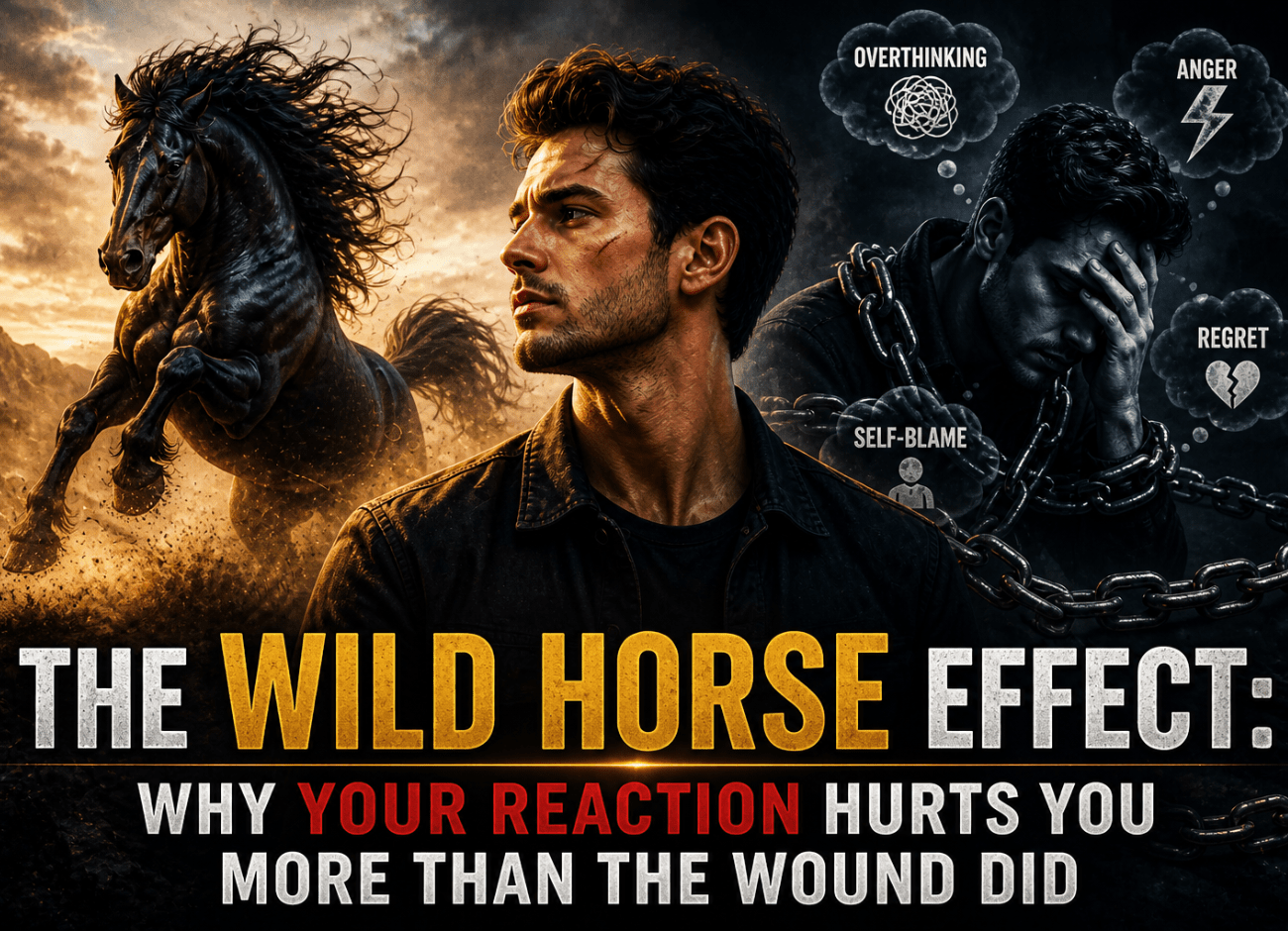
There’s actually a name for this in psychology. It’s called the Wild Horse Effect. And once you understand it, you’ll start seeing it everywhere – in your own life, in the people around you, in relationships, and in patterns you’ve never quite been able to explain.
Where the Name Comes From
In the forests of Africa, wild horses don’t sleep lying down. They rest standing up, which makes them vulnerable to a small creature called the vampire bat.
These bats bite the horses while they rest and draw a little blood. The bite itself? Minor. Not life-threatening. Not even particularly serious in the grand scheme of things.
But the horses don’t respond to it that way.
The moment they feel that bite, something in them panics. They take off running — frantically, desperately, as if something enormous is chasing them. They run themselves into exhaustion. And sometimes, they run until they die.
The bat didn’t kill them. The wound didn’t kill them. Their reaction to the wound did.
That’s the Wild Horse Effect.
The Snake and the Saw
Here’s another way to look at it.
Picture a saw lying on the ground – completely still, not moving, not threatening anyone. A snake slithers across it and accidentally grazes its skin. A small cut. A moment of pain.
And then the snake loses it.
Furious, it turns around and attacks the saw – biting it, wrapping around it, striking again and again. But the saw doesn’t care. It’s a saw. It just sits there with its sharp edges. And every time the snake attacks, it cuts itself deeper.
The saw didn’t go after the snake. The snake destroyed itself.
As one way of putting it goes: what really killed the snake wasn’t the motionless saw. It was its own out-of-control emotion.
This Is What We Do Too
Think about the last time someone said something that bothered you. Maybe it was a passing comment, a dismissive tone, a message left on read. Small things, objectively. Minor cuts.
But what happened after?
You replayed it. You built a story around it. You imagined conversations, rehearsed responses, filled in gaps with the worst possible interpretations. You told your friends. You lay awake thinking about it. You brought it up again days later.
The original wound stayed the same size. But your reaction turned it into something that took up your whole mind, drained your energy, and left you exhausted – all while the other person probably forgot it happened entirely.
That’s the Wild Horse Effect in action.
Why We React This Way
It’s not weakness. It’s wiring.
When something hurts us – especially if it echoes a wound from the past – our brain registers it as a threat. Neural pathways are created by past trauma, and when those pathways are activated, the emotional reaction may be drastically out of proportion to what actually happened.
This is why some people explode over things that seem tiny. Why a small criticism from a partner feels unbearable. Why being ignored for a few hours can feel like abandonment. The current situation isn’t always what you’re really reacting to. You’re reacting to everything that situation reminds you of.
The trigger is small. The emotional history behind it is not.
The Perspective Problem
Here’s something worth sitting with.
Hold a pen right up to your eye. It completely obscures your field of vision. It appears to be huge. You can only see it.
Now hold it at arm’s length. It’s just a pen.
The pen didn’t change. Your distance from it did.
When we’re in the middle of a painful reaction, we press our face right up against the problem. It fills everything. It feels all-consuming. But the problem is often the same size it always was — we’ve just lost all perspective on it.
Small problems, viewed too closely for too long, start to look like catastrophes.
Forgiving Isn’t Enough on Its Own
Most advice on emotional healing stops at forgiveness. Forgive the person who hurt you. Let it go. Move on.
And yes, forgiveness matters. But there’s a step people rarely talk about.
You also have to forgive the version of yourself that’s been holding onto the anger.
That part of you that keeps replaying the hurt, keeps picking at the wound, keeps attacking the saw — it isn’t bad. It’s scared.In the only way it knows how, it is attempting to keep you safe. However, it’s also what’s holding you back.
Pretending it didn’t hurt is not the same as letting go. It means choosing to stop adding new injuries on top of the original one. It means putting down the fight you’ve been having with something that can’t even feel you fighting it.
What Actually Helps
Recognize the gap. There’s the thing that happened — and then there’s your reaction to it. These are two separate things. The first, you often can’t control. The second, with practice, you can.
Ask yourself honestly — is my reaction right now proportional to what actually occurred? Or am I responding to the history this situation is touching?
Set boundaries — real ones. Not as punishment, not as walls — but as a way of protecting your emotional space so that smaller things don’t become big wounds in the first place.
Stop ruminating. Replaying the event doesn’t heal it. It just deepens the groove. Every time you go back to it, you’re attacking the saw again.
Give yourself time and distance. Most things that feel enormous today will feel very different in a week. Not because the hurt wasn’t real — but because perspective returns when you’re not pressing your face against the problem.
The Bigger Picture
Life will keep handing you small cuts. That’s not going to change. People will say the wrong things, situations won’t go the way you planned, and sometimes things will hurt for no fair reason at all.
The question was never whether you’d get hurt. The question is how fast you get back up.
The horses that died in the African forest weren’t brought down by vampire bats. They were brought down by their own uncontrolled response to something that, left alone, would have healed on its own.
Don’t be the horse. Don’t be the snake.
Feel the pain. Acknowledge it honestly. And then — slowly, with patience — choose not to run yourself into the ground over it.
“The cause might be nothing but a tiny wound. What leads to destruction is the excessive reaction that follows it.”
For Read More Click Here