

In a world obsessed with specialization, there is a rare breed of person who refuses to be boxed into a single label. They are scientists who paint, engineers who write poetry, entrepreneurs who study philosophy. They are called polymaths — and in today’s rapidly changing world, they might just have the biggest advantage of all.
What Exactly Is a Polymath?
Before diving into the how, it helps to understand the what.
Most people fall into one of two categories when it comes to knowledge:
| Type | What They Do | The Limitation |
|---|---|---|
| Specialist | Goes extremely deep into one field | Can develop tunnel vision; struggles outside their domain |
| Generalist | Picks up a little knowledge about many things | Lacks depth; rarely achieves real mastery in anything |
| Polymath | Achieves genuine depth across multiple diverse fields | Rare — but extraordinarily powerful |
The polymath is not simply someone who has tried many hobbies. The key word is mastery. A polymath goes deep — not just wide. They do not just sample fields; they build real proficiency in them.
History’s greatest minds were polymaths. Leonardo da Vinci was simultaneously a painter, sculptor, engineer, anatomist, and musician. Benjamin Franklin was a statesman, inventor, writer, and scientist. Marie Curie won Nobel Prizes in two completely different scientific disciplines — physics and chemistry. These were not people who dabbled. They were people who mastered.
Why Polymathy Matters More Than Ever
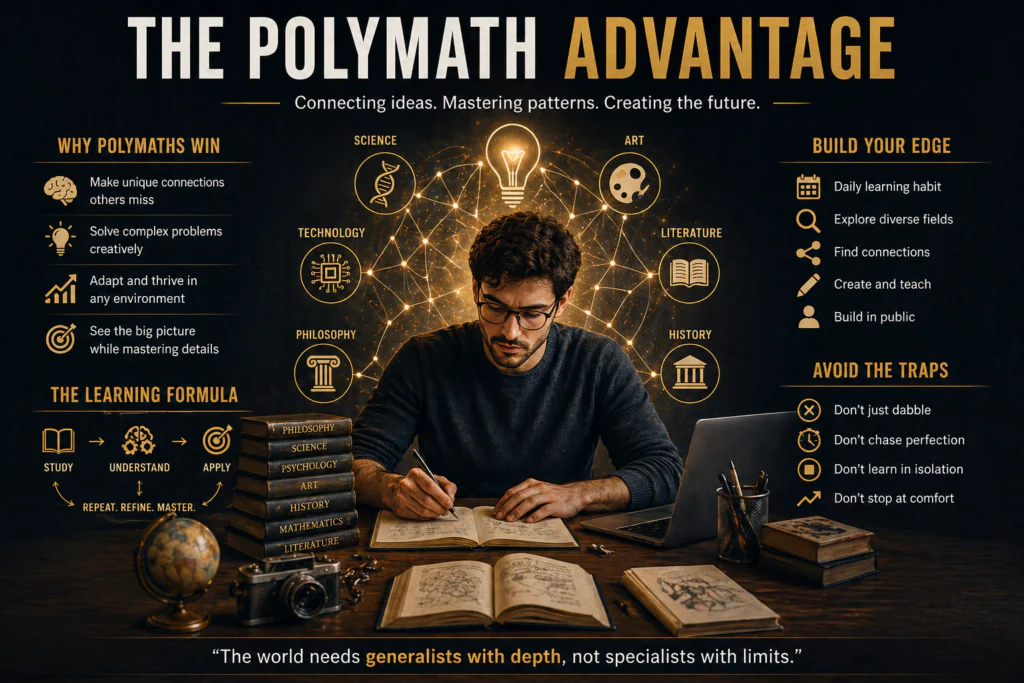
Here is the uncomfortable truth about hyper-specialization: it creates tunnel vision.
When someone only ever thinks inside one discipline, they can only ever solve problems using that discipline’s tools. A specialist economist sees every crisis as an economic problem. A specialist engineer sees every challenge as a design problem. But the most interesting problems in the world — and the most creative solutions — almost always live at the intersection of fields.
The good news? We are living in the greatest era for self-directed learning in human history.
The internet gives anyone access to world-class lectures, books, research papers, and tutorials for free or close to free. AI tools like ChatGPT can explain complex concepts in plain language, generate personalized study guides, and act as an on-demand tutor available around the clock. The barriers that once made polymathy the exclusive property of wealthy Renaissance aristocrats have effectively collapsed.
The question is no longer whether you can learn multiple skills. It is whether you are willing to.
Step One: Master Yourself Before You Master Anything Else
Every guide to skill-building jumps straight to tactics. This one will not — because the single biggest predictor of whether someone becomes a polymath is not their intelligence or their access to resources. It is their relationship with themselves.
Develop a Growth Mindset
The foundational belief you need is simple: your abilities are not fixed. Intelligence, creativity, and skill are not things you either have or don’t have at birth. They are things you build through consistent effort over time. People who believe their abilities are fixed give up when things get hard. People with a growth mindset understand that difficulty is the point — it is where growth actually happens.
Watch Out for the Dunning-Kruger Trap
The Dunning-Kruger effect describes a well-documented psychological pattern: beginners often overestimate how much they know, while true experts tend to underestimate their own knowledge. For the aspiring polymath, this matters because overconfidence kills curiosity. The moment you think you know enough about something, you stop learning. Stay humble. The deeper you go into any subject, the more you realize how vast it truly is.
Build Systems, Not Just Goals
Goals are useful for direction. Systems are what actually move you forward.
Setting a goal like “I want to learn Spanish” gives you a destination. Building a system — “I will study Spanish for 30 minutes every morning before checking my phone” — gives you a vehicle to get there. Systems create the consistent, manageable habits that compound over months and years into genuine mastery.
Protect Your Physical Foundation
This one gets skipped constantly, and it is a mistake. Your brain is a physical organ. Its performance depends directly on how you treat your body.
Regular exercise, quality sleep, and a reasonable diet are not lifestyle bonuses — they are cognitive necessities. A disciplined learning schedule built on top of a sleep-deprived, sedentary lifestyle will collapse. Build the physical foundation first.
Manage Your Time Like It Is Your Most Valuable Asset (Because It Is)
For a polymath pursuing multiple fields simultaneously, time management is not optional. Prioritize ruthlessly. Schedule your learning blocks the same way you schedule important meetings — with actual calendar entries, not vague intentions.
Minimize distractions aggressively. Phone notifications, social media, and background noise are learning’s worst enemies. Techniques like the Pomodoro method — focused work in 25-minute blocks followed by short breaks — are simple and remarkably effective. Use them.
What Real Mastery Actually Looks Like
There is a lot of mythology around mastery. The “10,000 hours” idea is well known but often misunderstood. Raw hours alone do not produce mastery. Four things together do:
| What’s Required | Why It Matters |
|---|---|
| Repeated Practice with Feedback | Hours without correction just reinforce bad habits |
| A Valid Environment | Skills learned in unpredictable environments don’t transfer reliably |
| Timely Feedback | The faster you learn what went wrong, the faster you correct it |
| Deliberate Practice | Deliberately targeting your weaknesses, not just doing what you’re already good at |
The last point is the one most people avoid. Deliberate practice is uncomfortable. It means spending your practice time on the things you find hardest, not the things that feel satisfying because you already do them well. But it is the only kind of practice that actually closes the gap between where you are and where you want to be.
Ideally, pair deliberate practice with genuine passion. Learning something you actually care about is not just more enjoyable — it produces better results, because curiosity drives you to go deeper naturally.
The Three Stages of Learning Any Skill
Whether you are picking up a new language, learning to code, or studying economics, your journey through any new discipline will follow roughly the same pattern:
Stage 1 — Recollection (Basic Learning) At this stage, you are primarily memorizing. You can repeat facts and definitions, but you do not yet truly understand what you have learned. This is a necessary foundation, but stopping here is a trap many learners fall into.
Stage 2 — Interpretation This is where real understanding begins. You can now explain concepts in your own words. You start connecting new ideas to things you already know. You can think critically about the material rather than just reciting it. This stage is where study transforms into actual knowledge.
Stage 3 — Application This is mastery territory. At this stage, you can teach the material to others, use it to solve real problems, generate new ideas within the field, and begin to identify the edges — the places where current knowledge runs out and where innovation lives.
The goal of every learning session should be to push toward Stage 3 as quickly as possible. Teaching what you learn — even to a friend, or in writing — is one of the fastest ways to get there.
The Three Pitfalls That Kill Polymaths Before They Start
Most people who want to become polymaths never do — not because they lack ability, but because they fall into one of three behavioral traps:
The Dabbler Starts everything with enormous enthusiasm. Buys the books, signs up for the course, tells everyone about their exciting new interest. And then, about three weeks in, when the initial novelty fades and the real work begins, quietly moves on to the next exciting thing. The Dabbler has a graveyard of abandoned skills.
The Obsessive Goes so hard so fast that they burn out completely. Practices for 6 hours a day for two weeks, then collapses into exhaustion and gives up entirely. The Obsessive mistakes intensity for consistency — and pays for it.
The Hacker Reaches a comfortable level of competence and stops. Never pushes beyond the point where things get hard again. Has been “learning guitar” for five years but still plays the same four chords. The Hacker settles for good enough.
The path of the true polymath runs between all three. Consistent without being obsessive. Persistent without being rigid. Always pushing slightly beyond comfort — but never so far that burnout becomes the result.
Practical Tools to Accelerate Your Learning
Once the mindset and the habits are in place, a range of practical techniques can dramatically speed up the process:
Speed Reading Not about racing through text mindlessly — it is about learning to skim strategically, identifying the most valuable content in any piece of writing and spending your focus there.
Memory Techniques Active recall (testing yourself rather than passively re-reading), spaced repetition (reviewing material at increasing intervals), mnemonics, and chunking (grouping related information) are all proven methods for retaining more of what you learn.
Critical Thinking Do not accept ideas passively. Analyze them. Ask where the evidence comes from. Apply both inductive reasoning (drawing general conclusions from specific examples) and deductive reasoning (applying general principles to specific cases). Questioning is learning.
Cross-Disciplinary Integration This is the polymath’s secret weapon. When you study multiple fields simultaneously, you start to notice patterns and connections that specialists miss entirely. Concepts from game theory illuminate business strategy. Principles from architecture show up in writing structure. Biology informs economics. The more fields you know, the richer each individual field becomes.
Use AI Intelligently Tools like ChatGPT and Google’s NotebookLM are genuinely powerful learning accelerators when used well. Ask them to explain concepts in simpler terms. Request practice questions. Have them summarize dense material or generate study plans. Used as a tutor rather than a shortcut, AI can compress months of learning into weeks.
Find a Mentor Good mentorship is irreplaceable. A mentor who has already walked the path you are trying to walk can save you years of wasted effort by pointing out the mistakes before you make them. Seek out communities of people pursuing similar goals — the feedback, accountability, and shared knowledge are invaluable.
Build Your Personal Brand Along the Way
Here is a strategy that most people overlook: share your learning publicly.
Write about what you are studying. Post about your progress. Teach what you know to others — even when you are still learning it yourself. This does the following:
It forces clarity of thought (you cannot write clearly about something you do not understand). It creates accountability (public commitments are harder to abandon quietly). It builds an audience of people interested in the same things you are. And it develops communication skills — itself one of the most valuable skills a polymath can have.
The process of explaining what you are learning is, in itself, one of the most powerful learning techniques available to you.
The Polymath Mindset: What Ties It All Together
After all the strategies, techniques, and tools, what actually separates the people who become polymaths from those who merely aspire to?
Three things:
Curiosity. Not forced curiosity. Genuine, relentless curiosity about how the world works. Polymaths are people who cannot help but ask “why” and “how” — about everything.
Resilience. Every learning journey hits plateaus. Periods where you are putting in the hours and seeing no progress. These plateaus are not signs of failure. They are signs of consolidation — your brain integrating everything it has absorbed before the next leap forward. The people who push through plateaus are the ones who master things.
Love of the Process. Results are slow. Progress is invisible on a day-to-day basis. If your motivation depends on feeling like you are advancing every single day, you will give up. The polymaths who succeed are the ones who genuinely enjoy the act of learning itself — not just the destination it leads to.
A Final Word: Start Today
The best time to begin building a second skill, or a third, or a fifth, was years ago. The second-best time is right now.
You do not need to be Leonardo da Vinci. You do not need to win Nobel Prizes in multiple fields. You simply need to be someone who never stops learning, never stops questioning, and never fully settles into the comfortable limitation of a single identity.
The world already has enough narrow specialists. What it needs — what it has always needed — are people who can think across boundaries.
Start now. Stay curious. Love the process.
That is how you become a polymath.
Found this useful? Share it with someone who is always learning something new.